The worst time to learn that your designer owns your domain is the day you decide to leave.
Updated August 2026. Written by the We Lead team in Naples, FL. This is what we tell people who are interviewing us, including the parts that make it easier to say no to us.
Almost every web design company in Naples can build something that looks good. The differences that decide whether you regret the decision show up months later: who owns the domain, whether the site is fast on a phone, whether anyone can find it in search, and what happens the week after launch. Ask about those four things and the field narrows very quickly.
Choosing a web design company is uncomfortable because the thing you are buying does not exist yet. You cannot test drive it. You are judging a portfolio of finished work against a promise about your own, and portfolios are curated by definition. So the useful questions are not about taste. They are about what happens when the pretty part is done.
What actually separates one web design company from another?
Looks are table stakes now. Templates got good, and any competent designer can produce something clean. The real gap sits in everything you cannot see from the homepage: how fast the site loads on a phone on cell service, how it is structured so search engines can read it, who controls the accounts underneath it, and whether anyone answers the phone in month three.
A beautiful site that nobody finds is a brochure with a hosting bill. That is the most common thing we are called in to fix, and it is rarely the designer’s fault in the narrow sense. The site does exactly what it was scoped to do. Nobody scoped it to be found. If being found matters to you, say so out loud before you sign, and look for a firm that treats web design in Naples and search as one job rather than two purchases.
What should a website in Naples actually cost?
Any professional build starts at $2,500. The $2,500 to $6,000 range covers most small business sites in Southwest Florida: a proper structure, real content, mobile performance, and the search groundwork that lets the site compete. Custom builds and e-commerce start at $6,000 and rise with complexity.
Below that range you are not buying a cheaper version of the same thing. You are buying a different thing, usually a template with your logo dropped in and stock photography of a coastline that is not this one. That is a legitimate choice for a business that just needs an address on the internet, and a poor one for a business that needs the site to sell. The full breakdown, including what moves the number, is in our guide to what a website costs in Naples.
Which five questions end a sales call early?
Print these. Ask them in the first conversation, before anyone shows you mockups. The answers sort firms faster than any portfolio review.
| Ask this | A good answer sounds like | A weak answer sounds like |
|---|---|---|
| Who will own the domain and the hosting account? | You do. Both are registered in your name, and we get added as a user. | We take care of all that for you, do not worry about it. |
| Can I see a site you built two years ago? | A live link, plus an honest word about how it has held up. | Only brand-new work, or screenshots instead of URLs. |
| What speed score will my site launch with? | A number they are willing to be measured against, on mobile. | Speed depends on a lot of factors. |
| Who writes the words on the pages? | A clear owner, and a process for pulling what only you know out of your head. | We will drop in placeholder text and you can change it later. |
| What happens the week after launch? | A named support window, one person to contact, and what is included. | Then it is live. |
How do you check their work before you sign?
You do not need to be technical to verify most of this. All of it takes under twenty minutes, and none of it requires their permission.
Run the speed test yourself
Take a client site from their portfolio, paste the URL into Google PageSpeed Insights, and read the mobile tab. Mobile is the one that matters and the one that usually collapses. Anything in the 90s is strong; a perfect score is rare on complex sites, and a firm that hits it consistently is showing off in the best way.
Open it on your phone, off wifi
Cell service across Collier County is not what it is downtown. A site that only feels fast on office fiber is not fast.
Search for their client
Type that client’s service and city into Google. If nothing they built ever surfaces, the firm builds sites, not visibility.
Check who owns the domain
A public whois lookup shows the registrant. If the agency name is on a client domain, you have learned something important.
Ask for a client who left
Every firm has them. The willingness to name one, and to say what went wrong, tells you more than five happy references.
Who owns the site when the relationship ends?
This is the question that costs the most money when it gets skipped, and it is almost never asked during a sales call because it feels like planning a divorce at the wedding. Ask it anyway.
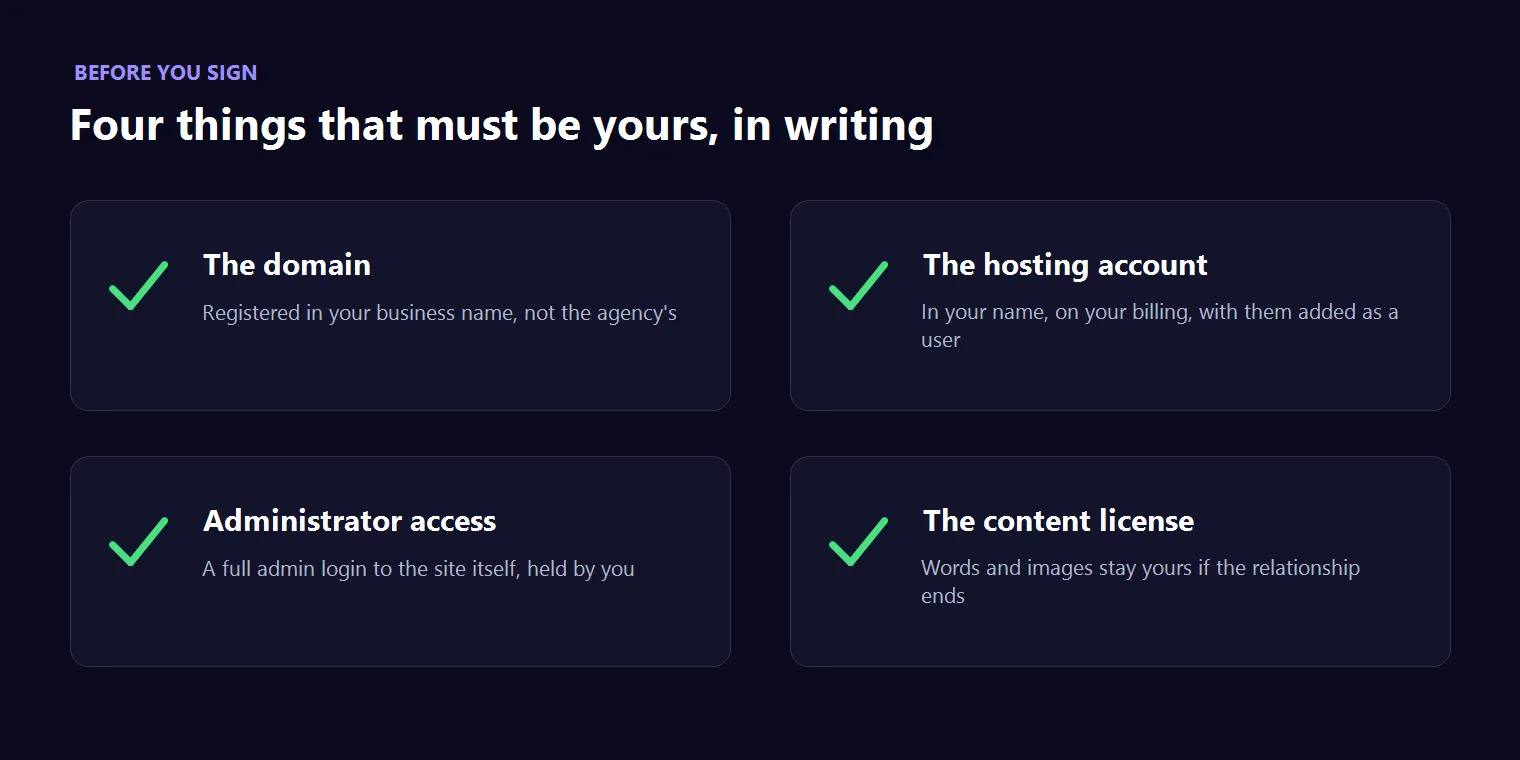
Four things should be yours in writing: the domain, registered in your business name; the hosting account, in your name with your billing; administrator access to the site itself; and a license to the content and images that survives the relationship. If any of those sit with the agency, leaving means either rebuilding from scratch or negotiating from a very weak position.
There is a softer version of the same trap. Some builds depend so heavily on one proprietary page builder or one subscription platform that the files are technically yours and practically useless to anyone else. How the main platforms compare on exactly this point is in WordPress vs Wix vs Squarespace. Ask what a new developer would need in order to take over, and listen for whether the answer is a straight one.
What are the red flags?
When should you start, if your season runs November to April?
This one is specific to where we live, and almost nobody raises it. If your revenue concentrates between November and April, a rebuild that goes live in January is a risk taken at the worst possible moment. New sites move around in search for a few weeks after launch while Google re-reads everything, and forms break in ways nobody predicts. You want that turbulence in July, not in the middle of season.
Working backwards from that: content and photography are the slow part, not the code. Most delays we see trace back to someone waiting on photos or approvals rather than to anything on the build side. Starting in late spring puts a summer build and an early autumn launch comfortably ahead of the first snowbird searches.
Should the same company handle search?
Not necessarily, but somebody has to, and it should be decided before the build rather than after. A site’s structure, page names, internal links and speed are all search decisions made during design. Retrofitting them costs more than building them in.
If the design firm does not do search, ask them to work alongside whoever does. If nobody does, understand that you are commissioning a brochure and budget accordingly. How we see the two fitting together is on our SEO services in Naples page, and the compounding math against paid traffic is in SEO versus paid ads. If you end up interviewing search firms separately, the equivalent checklist for that side is how to choose an SEO company in Naples.
Frequently asked questions
Interviewing companies right now? Our free audit tells you where your current site actually stands: mobile speed, what Google can and cannot read, and where you sit in Naples search results, with numbers instead of adjectives. Use it as a baseline whether or not you hire us. Request the free audit or see what our Naples web design work includes.
About this guide. We Lead is a marketing agency in Naples, FL that builds websites and runs the search campaigns behind them. The checks recommended above are the ones we invite clients to run on us: this page scores 100 across all four Google PageSpeed categories, and the campaign documented in our +644% case study is published with the real Search Console charts. Questions about your own situation: ask for the free audit. Once the site is live, run our seven-point website security check on it.