Before your next customer calls anyone, there is a growing chance they will ask a chatbot who to call.
First published August 2026, updated October 2026 with a follow-up check. Written by Rares Rata, who runs SEO and AI Search at We Lead in Naples. Everything below comes from a test we ran ourselves and logged source by source. No tools to buy, no theory, and one result that stung us personally.
We asked two AI platforms, Perplexity and Google AI Mode, who to hire in Naples, FL. Six buyer questions, twelve answers, 95 cited sources logged. What actually decided who got recommended: a complete Google Business Profile (it supplied the names, ratings and addresses), a website that makes concrete, verifiable claims (it supplied the descriptions), and directory profiles like Yelp and Houzz (they spoke for the businesses whose websites had nothing worth quoting). Not company size, not advertising budget. If your profile is not surfacing in the first place, that is a separate problem: why a business does not show up on Google Maps.
There is a lot of noise about ranking in AI search right now, most of it written far from any actual data. So we did the thing anyone can do and almost nobody does: we asked, we wrote down every source the AI cited, and we looked for patterns. This is what came back for Naples businesses, with no company names, because the point is not who won. The point is why they won.
How did we run the test?
Six questions a real buyer would type, covering local industries: home building, kitchen remodeling, real estate, flooring, and two more we kept for internal tracking. Each question ran on Perplexity and on Google AI Mode in the same session, on the same day. For every answer we logged which businesses were named, which websites were cited as sources, and what kind of page each citation pointed to.
No paid tools, no API tricks. You can repeat this for your own industry in twenty minutes, and we recommend you do, because the answers change and the only baseline that matters is yours.
What actually decided who got recommended?
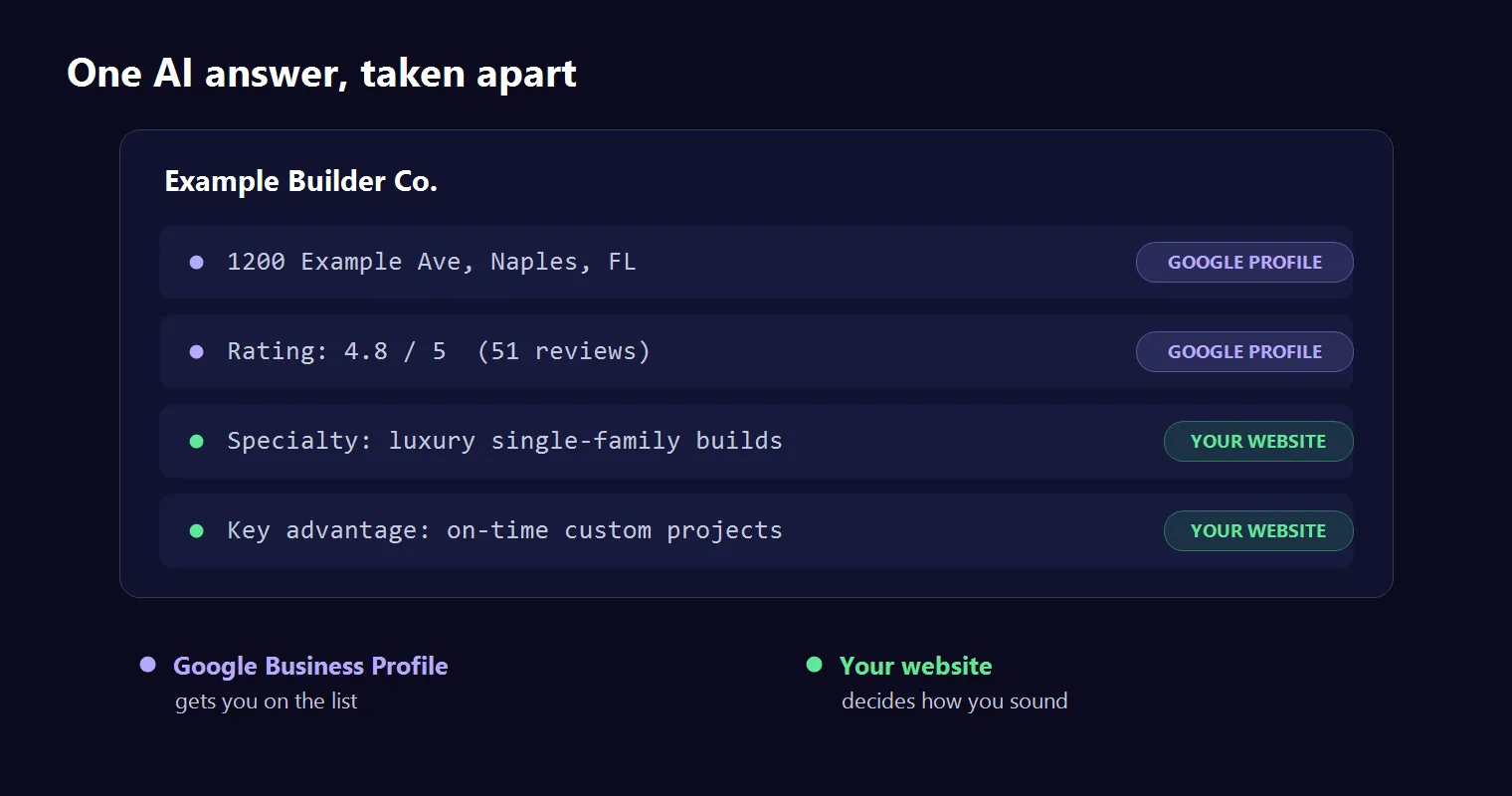
The clearest evidence came from Google AI Mode. When we asked for the best home builder, it answered with a map first, then a structured list. Every business on that list was assembled from exactly two places:
The Google Business Profile
The street address, the star rating, the review count, even the “open until” line. This data decided who made the list at all.
The business website
The “specialty” and “key advantage” lines were lifted from each firm’s own pages. This data decided how each business was described once it made the list.
Two sources, two different jobs. The profile is the entry ticket. The website is the sales pitch. A business missing either one competes with half a voice.
What happens when your website has nothing to quote?
This was the most uncomfortable finding, and it came from the kitchen remodeling question. Google AI Mode cited the remodelers’ own websites. Perplexity answered the same question by citing nothing but directories: the businesses were named, but every description came from their Houzz profiles.
Same companies, same day, two completely different narrators. On one platform the businesses spoke for themselves. On the other, a directory spoke for them, in whatever words happened to sit on a profile page nobody had updated in years.
What did each platform actually lean on?
| Question about | Google AI Mode leaned on | Perplexity leaned on |
|---|---|---|
| Home builders | Business Profile data plus each firm’s own website | Firms’ own websites, then Houzz, BuildZoom, Angi |
| Kitchen remodelers | Firms’ own websites plus Houzz and Thumbtack | Directories only; no firm website cited at all |
| Realtors | The winner’s own site plus industry rankings | A review aggregator first, then portals, then Reddit |
| Flooring stores | Six store websites plus Yelp | Ratings, review counts and hours in the answer itself |
Two details in that table deserve a second look. Yelp was cited as a source by Google’s own AI, which settles the question of whether directory profiles still matter. And Reddit showed up in the sources for a “who is the best” question, which tells you these systems treat real people’s opinions as evidence, not as noise.
The four patterns that repeated everywhere
Concrete claims get quoted
The lines the AI lifted were verifiable facts: years in business, licenses held, areas served, a named specialty. Not one adjective like “premier” or “trusted” survived into an answer on its own.
The complete profile wins the list
Ratings, review counts, hours and addresses appeared directly inside answers. Businesses with thin or unclaimed profiles simply were not in the conversation.
Titles that match the question win
One business took first place on both platforms, and its cited page carried the buyer’s exact question in the page title. That is not a coincidence you ignore.
No platform sees the whole market
The two platforms overlapped far less than you would expect. Being visible on one says nothing about the other, so a single check is an anecdote, not a measurement.
What changed when we asked again in October?
On October 14, 2026 we asked the same six questions again, mostly from a Florida connection, and repeated the key questions several times.
| Question about | What moved by October 14 |
|---|---|
| Home builders | Little. Google AI Mode still built its list from the builders’ own websites and cited Yelp; Perplexity still mixed builder websites with Houzz and BuildZoom, and added Zillow. |
| Kitchen remodelers | The biggest shift. Perplexity, which cited only directories in August, now cited remodelers’ own websites alongside Houzz. Google AI Mode cited the firms’ own sites only, with no Houzz or Thumbtack this time. |
| Realtors | Google AI Mode combined agents’ own websites with an industry ranking, as in August. Perplexity opened with an agent’s own site this time, where in August it opened with a review aggregator. |
| Flooring stores | Google AI Mode leaned on the stores’ own websites, with Yelp cited in one of three runs. Perplexity named the stores and quoted store websites. |
The direction matches what August pointed to: inside the answers, businesses’ own websites did more of the talking, and directories became the backup rather than the narrator. One caution we learned the hard way: answers changed from run to run, with where the question was asked from, and with whether the browser was signed in to an account. That is why every check from now on runs from Florida, logged out, several times per question.
Did we pass our own test?
No. We also asked both platforms about marketing and web design in Naples, and We Lead was not in those answers YET. We are publishing that anyway, because a baseline you hide is a baseline you cannot improve, and because everything on the checklist below is what we are doing for ourselves right now: completing profiles, claiming directories, and putting quotable facts where machines and people can both read them. We will run the same six questions again in ninety days and report what moved.
October 14 update: mostly still no. Checked from Florida with no account signed in, Google AI Mode did not name We Lead for web design, and Perplexity named us for neither question. ChatGPT, which we added in October, mentioned us in two of three runs for the marketing question, once in its main list and once as an extra suggestion. A first sign, not a win. Since August we have published a dedicated page on AI search visibility, corrected the logo and business details that AI assistants read from our site, and kept publishing pages that answer buyer questions directly. The November check, on all three platforms with every question repeated, will show whether it holds, and we will publish the result either way.
Next measurement: November 2026
What can a Naples business do about this, starting this week?
Everything the test rewarded is work a local business can start immediately. In order of impact:
Complete your Google Business Profile
Services, hours, photos, a real description and a steady flow of reviews.
In the test: ratings, review counts and addresses appeared inside the AI answers themselves.
Put concrete facts on your website
Founding year, licenses held, areas served, what you specialize in. Facts a machine can verify and a customer can trust.
In the test: those exact kinds of lines were quoted word for word.
Claim your directory profiles
Starting with Yelp: claimed, accurate and consistent with your Google profile.
In the test: Google’s own AI cited Yelp, and Perplexity described entire industries through Houzz alone.
Answer real buyer questions, question in the title
One page per question buyers actually type, with the question as the headline.
In the test: the page titled with the buyer’s exact question won on both platforms.
Measure on more than one platform
Set a baseline for the questions that matter to you, then recheck quarterly.
In the test: the two platforms disagreed constantly; a single check is an anecdote.
None of this is exotic. It is the same foundation that good local search has always rewarded, which is also what Google itself says about AI features: no special markup, no secret tricks, just the fundamentals, done properly. The difference is that AI answers compress the whole market into three or four names, so the gap between “done” and “done properly” has never been more visible. If being one of those names matters to your business, that work is exactly what our SEO and AI visibility service in Naples exists for, and the thinking behind organic versus paid visibility is laid out in SEO versus paid ads.
Frequently asked questions
Want to know what AI says about your industry? Request the free audit and we will run your buyer questions across AI platforms, alongside your rankings and your site’s technical health. Or start with the foundation: our Naples web design work builds sites with something worth quoting.
About the author. Rares Rata runs SEO and AI Search at We Lead in Naples, FL. This test is part of the ongoing tracking we do for our own market, published with the method so you can repeat it. The site you are reading scores 100 across all four Google PageSpeed categories, and the campaign in our +644% case study is published with the real Search Console charts. Questions about where you stand: ask for the free audit.